

The March CPI confirmed what the energy shock made inevitable. Now the U.S. has imposed a naval blockade on the Strait of Hormuz, and economists are already warning April will be worse. Here's where things stand.
For weeks, the headlines have been describing an inflation crisis in real time: surging oil, paralyzed shipping lanes, disrupted fertilizer supplies. On April 10th, the official data confirmed it.
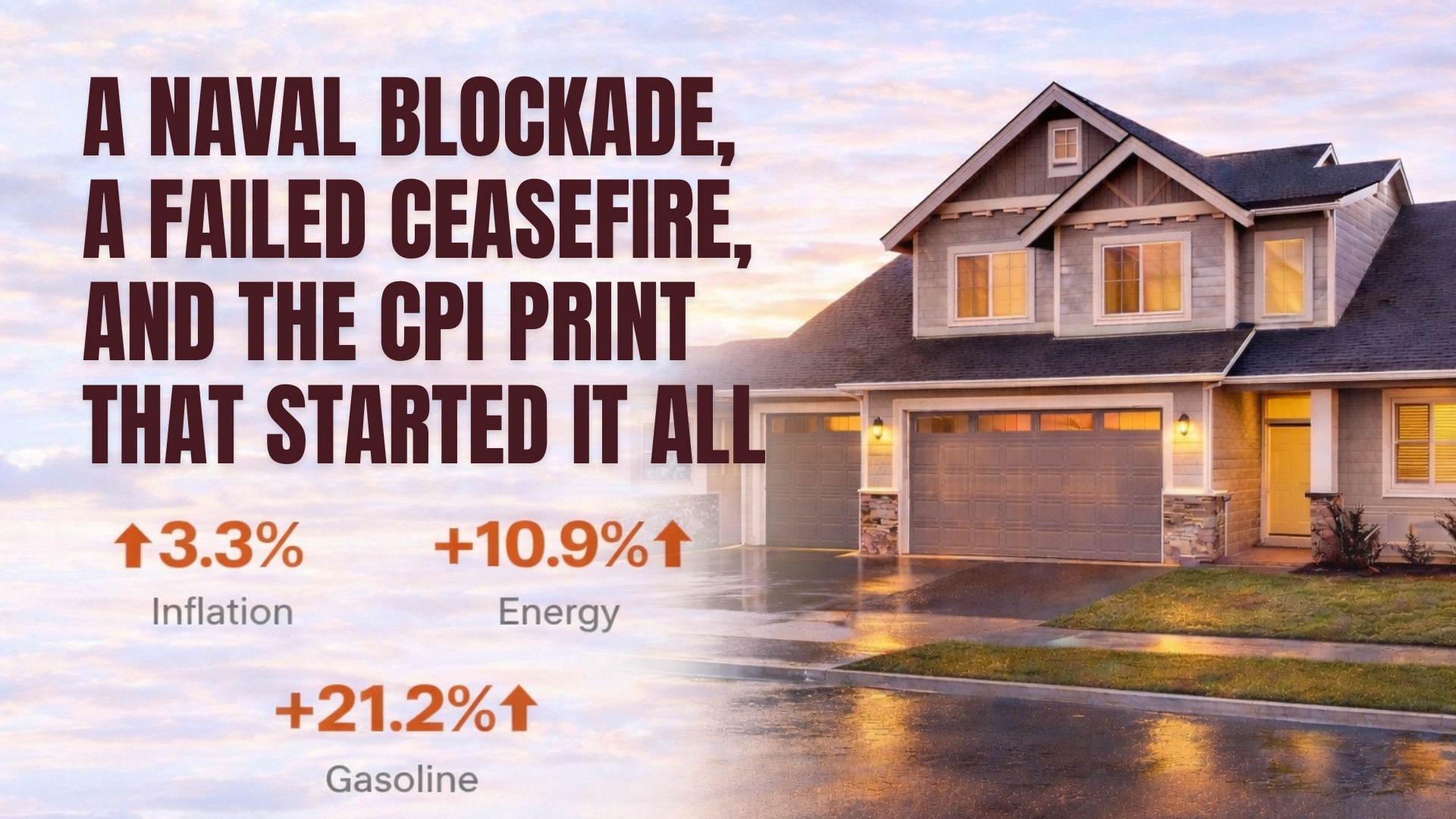
The Consumer Price Index for March came in at a 3.3% annual rate, the highest reading in nearly two years and nearly a full percentage point above February's 2.4%. Energy prices drove it up 10.9% in a single month, with gasoline rising 21.2% from February, the sharpest monthly increase since 1967. The last time Americans saw a price increase like that at the pump, Richard Nixon was president and the OPEC embargo had only just begun.
The data is telling. But here is the part worth understanding: March only captured the early weeks of the conflict. Unfortunately, the situation since then has not improved and has only escalated.
When a temporary ceasefire was announced on April 7th, markets rallied and most investors exhaled. We noted at the time, in our piece on what the IMF's starkest warning meant for your capital, that the structural inflation forces we had been tracking since early March had not been resolved. That turned out to be the right read.
Iran never meaningfully reopened the Strait of Hormuz. By April 9th, ships were once again being blocked from passing through. The U.S. and Iran held direct peace talks in Islamabad on April 11th and 12th. On April 12th, Vice President Vance announced the talks had failed.
On April 13th, the United States imposed a full naval blockade on Iranian ports. As of today (4/16/2026), 10,000 U.S. sailors and Marines, more than a dozen warships, and dozens of aircraft are enforcing the blockade. An estimated 230 loaded oil tankers are sitting stranded inside the Gulf.
The ceasefire that was supposed to ease tension has given way to an active U.S. naval operation in one of the world's most critical waterways.
Also today, the IMF released its April 2026 World Economic Outlook, its most comprehensive global assessment of economic trends for the year.
The IMF now forecasts global inflation at 4.4% for 2026, up 0.6 percentage points from its prior projection, driven by surging oil, gas, and fertilizer costs. Global growth was cut to 3.1%, down from 3.4% last year. For the U.S. specifically, the IMF projects inflation averaging 3.2% in 2026, reinforcing what we first noted in this series back in March: the path back to the Fed's 2% target would be longer and harder than most forecasters had originally estimated.
The IMF's most severe scenario, where energy infrastructure damage extends disruptions into next year, projects global inflation approaching 5.8% and annual growth near recession territory, a combination that has occurred only four times since 1980.
U.S. Energy Secretary Chris Wright said plainly this week that energy prices will remain elevated and will potentially rise further until meaningful ship traffic begins to move through the Strait. That, he estimated, could be weeks away.
The March CPI was the first report to fully reflect the war's impact on energy prices. But economists have already flagged what comes next.
Oxford Economics' lead U.S. economist Bernard Yaros said in the immediate aftermath of the March print that the April CPI will be "uncomfortably strong", driven by continued high gas prices and additional upward pressure from data disruptions. Heather Long, chief economist at Navy Federal Credit Union, put it more directly: "This is only the beginning. Food prices, travel and shipping costs are all going up in April and will exacerbate the pain."
The effects of the fertilizer disruption we flagged in earlier coverage is now working its way into diesel and transportation costs, which will in turn affect the price of nearly every physical good that moves by truck. The inflationary chain that started with oil prices is now branching into food, apparel, and logistics, exactly the pattern that makes this kind of inflation durable and a long-term effect rather than transitory.
Through all of it, the ceasefire, the failed talks, the blockade, the CPI print, the logical argument for holding inflation-resistant physical assets has only strengthened.
Debt-free real estate sits in a different category from most investments in this environment. Bonds lose ground as inflation erodes fixed payments. Cash loses purchasing power steadily. Stocks face pressure when borrowing costs stay elevated and consumer spending slows. Leveraged real estate takes a hit when interest rates remain high, because carrying costs rise and refinancing becomes expensive.
A property with no mortgage has limited exposure to those market vulnerabilities. The property’s value is tied to what it is, a physical asset with a demand floor, not to its financing or what the Fed does next.
In Princeton, Texas, the fastest-growing city in the United States, with a 30.6% population surge recorded between July 2023 and July 2024 alone, Realbricks currently has two new construction properties available for fractional ownership: Jameson and Macallan. Both are 2026 builds, acquired debt-free with no mortgage or interest rate exposure, and currently offered at $250,310 — an 18.59% discount to the retail listing price of $307,490 (Source).
Both new homes carry a 1-year builder warranty. The minimum investment is $100.
In a week where the March CPI confirmed surging inflation, the IMF cut its global growth forecast, and a U.S. naval blockade began in the world's most important oil corridor, the question of where to position capital is not abstract. You can explore both properties on the marketplace and review the full offering details before committing anything.
Disclaimer: Investing in real estate involves risks, including the potential loss of capital. This content is for informational purposes only and is not intended as investment advice. Investors should perform their own research and consult with financial professionals before making investment decisions.
Be the first to know about property launches, portfolio updates, and announcements by subscribing to our newsletter.


Terra Mint Group, Corp ("Terra Mint"), as the Managing Member of Neptune REM, LLC ("Neptune") operates the RealBricks.com website (the "Site") and is not a broker-dealer or investment advisor. All securities related activity is conducted through Dalmore Group LLC, a registered broker-dealer and member of FINRA/SIPC, located at 525 Green Pl. Woodmere, NY 11598. You can review the brokercheck for Dalmore. An up-to-date Dalmore Form CRS is available.
You should speak with your financial advisor, accountant and/or attorney when evaluating any offering. Neither Terra Mint, Neptune, nor Dalmore makes any recommendations or provides advice about investments, and no communication, through this website or in any other medium, should be construed as a recommendation for any security offered on or off this investment platform. The Site may make forward-looking statements. You should not rely on these statements but should carefully evaluate the offering materials in assessing any investment opportunity, including the complete set of risk factors that are provided as part of the offering circular for your consideration.
Neptune is conducting public offerings pursuant to Regulation A, as amended, through the Site. The most current offering circular for Neptune is available here. Past performance is no guarantee of future results. Investments such as those on the Realbricks platform are speculative and involve substantial risks to consider before investing. These risks are outlined in the respective offering materials and including, but not limited to, illiquidity and a complete loss of capital. Key risks include, but are not limited to, limited operating history, reliance on key personnel, inherent risks in investing in real estate, distributions may not be received on predictable schedule and or at all by Investors, and lack of voting rights. Also, the adverse economic effects of the COVID-19 pandemic remain unknown and could materially impact this investment. An investment in an offering constitutes only an investment in a particular series and not in the underlying asset(s). Investors should carefully review the risks located in the respective offering materials for a more comprehensive discussion of risk.
From time to time, Neptune may undertake "testing the waters" for additional series of securities to be offered pursuant to Regulation A. For offerings that have not yet been qualified, no money or other consideration is being solicited, and if sent in response, will not be accepted.
NO MONEY OR OTHER CONSIDERATION IS BEING SOLICITED, AND IF SENT IN RESPONSE, WILL NOT BE ACCEPTED.
NO OFFER TO BUY THE SECURITIES CAN BE ACCEPTED AND NO PART OF THE PURCHASE PRICE CAN BE RECEIVED UNTIL THE OFFERING STATEMENT FILED BY THE COMPANY WITH THE SEC HAS BEEN QUALIFIED BY THE SEC. ANY SUCH OFFER MAY BE WITHDRAWN OR REVOKED, WITHOUT OBLIGATION OR COMMITMENT OF ANY KIND, AT ANY TIME BEFORE NOTICE OF ACCEPTANCE GIVEN AFTER THE DATE OF QUALIFICATION.
AN INDICATION OF INTEREST INVOLVES NO OBLIGATION OR COMMITMENT OF ANY KIND.
AN OFFERING STATEMENT REGARDING THIS OFFERING HAS BEEN FILED WITH THE SEC. YOU MAY OBTAIN A COPY OF THE PRELIMINARY OFFERING CIRCULAR THAT IS PART OF THAT OFFERING STATEMENT FROM: Neptune REM, LLC 412 W Norfolk Ave STE 2, Norfolk, NE 68701 OR HERE.
Investment overviews contained herein contain summaries of the purpose and the principal business terms of the investment opportunities. Such summaries are intended for informational purposes only and do not purport to be complete, and each is qualified in its entirety by reference to the more-detailed discussions contained in the respective offering circular filed with the SEC.
Realbricks does not offer refunds after an investment has been made. Please review the relevant offering materials and subscription documentation for more information.
Potential investors should not rely on any forward-looking statements regarding any investment opportunity, which is based on our beliefs and information currently available to us. The words “anticipate,” “believe,” “expect,” “aim,” “potential,” “design,” “target,” “intend,” “may,” “might,” “plan,” “estimate,” “project,” “projection,” “should,” “will,” “would,” “result” and similar expressions identify forward-looking statements. Such statements are subject to risks, uncertainties, and assumptions and are not guarantees of future performance, which may be affected by known and unknown risks, trends, uncertainties, and factors that are beyond our control. These risks could result in the loss of your investment. See the offering materials for detailed information.
Neptune does not have a public trading market for its Series Interests. While it intends to seek a quotation on PPEX, an alternative trading system (ATS) operated by North Capital Investment Technology, Inc. (“PPEX”) with a view to providing our holders of Series Interests with potential liquidity in the form of a secondary market for their investment in our Series Interests. However, there can be no guarantee that a secondary market may develop, or if it does, as to the volume or pricing with respect to any secondary trading that might develop. The PPEX does not employ market makers to provide liquidity, unlike national securities exchanges. Until Neptune’s Series Interests are listed, if ever, you may not sell the company’s Series Interests. Therefore, it may be difficult for you to sell Neptune’s Series Interests at the time you wish to do so, if you are able to sell them at all. If you are able to sell your Series Interests, you may have to sell them at a substantial discount to their public offering price. Because of the illiquid nature of our Series Interests, you should purchase Neptune’s Series Interests only as a long-term investment and be prepared to hold them for an indefinite period of time.
Property information shown has been provided from various sources, which can include the seller and/or public records. It is believed reliable but not guaranteed and should not be relied upon without independent verification.
Disclaimer: Images, Information and Floor Plan and Measurements are approximate and are for illustrative purposes only. We make no guarantee, warranty or representation as to the accuracy and completeness of the floor plans, measurements and or any information provided. You or your advisers should conduct a careful, independent investigation of the property to determine to your satisfaction as to the suitability of the property for your space requirements. All pricing and availability is subject to change. The information is to be used as a point of reference and not a binding agreement.


