

What do you own when you invest, when distributions may be paid, who can invest, and how do I report this on my taxes? Answering real questions from Realbricks investors.
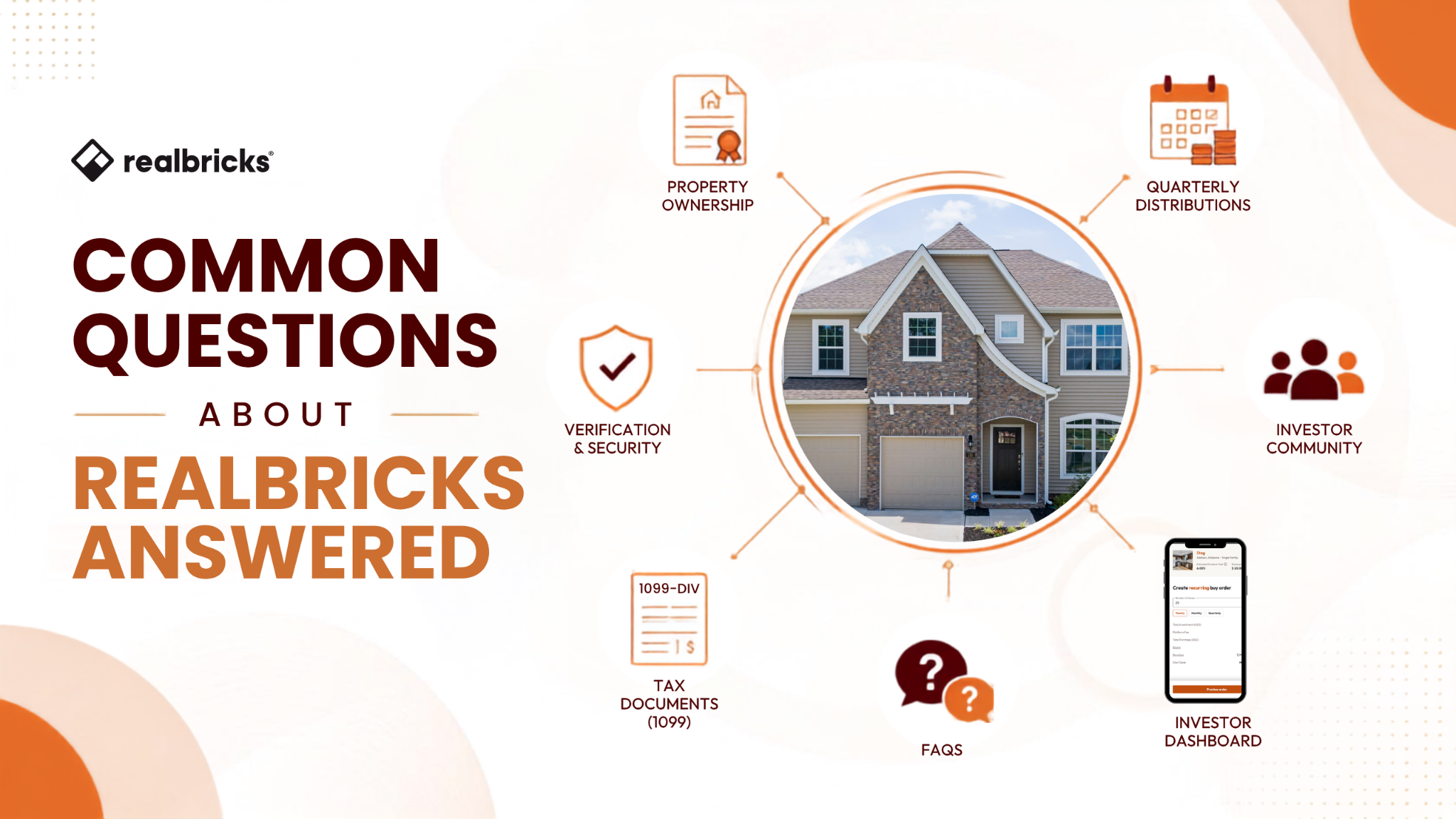
Every week, investors share their questions about how Realbricks works. This page answers the questions we hear most often, and we will continue to update this article as new questions come in. If you are new to Realbricks, our guide to how Realbricks works is a good place to start.
When Realbricks acquires a home, that property is placed into its own separate legal entity. The investment opportunity for that property is then divided into ownership interests, or shares, priced at $10 per share (minimum investment of $100).
When you invest, you are purchasing these shares in the entity that owns the property. You do not directly own the home, your name is not placed on the property title, and you do not have direct ownership of the physical real estate. Instead, you own an interest in the legal entity that owns that specific property, along with other investors who purchase interests in the same series.
If a property generates positive net operating income, investors may receive cash distributions based on their ownership interest. Any distributions, if declared, are processed on a quarterly basis.
Distributions are not guaranteed and may vary depending on property performance, operating expenses, reserves, financing obligations, and other factors. We published a full guide on this: How Distributions Work on Realbricks.
Realbricks offerings are available to eligible non-accredited and accredited investors, subject to the requirements of Regulation A+ and applicable law. You must be at least 18 years old to open an account.
To get started, open an account, complete the required identity verification process, link an eligible U.S. bank account, and fund your account (minimum investment is $100). Once your account is approved and funded, you may review available SEC-qualified offerings and invest in accordance with the terms of each offering.
Distributions paid are reported to investors on a 1099-DIV, the same tax form used for dividend income. Importantly, tax reporting for a Realbricks investment may differ from that of owning a rental property directly.
This information is provided for general educational purposes only and should not be considered legal or tax advice. Tax treatment depends on an investor's individual circumstances. Investors should review the applicable offering documents and consult their own tax adviser regarding their specific situation.
Reach out through the app or reply to any of our emails and ask. The questions investors send are what shape guides like this one, and we will keep adding to this page as new questions come in.
You can explore current offerings on our marketplace, or review our offering circular for complete details on every offering.
Disclaimer: Investing in real estate involves risks, including the potential loss of capital. This content is for informational purposes only and is not intended as investment, legal, or tax advice. Distributions are not guaranteed and depend on a property being tenanted, collecting rent, and generating net operating income; they may vary or may not be paid. Investors should perform their own research and consult with financial and tax professionals before making investment decisions.
Be the first to know about property launches, portfolio updates, and announcements by subscribing to our newsletter.


Terra Mint Group, Corp ("Terra Mint"), as the Managing Member of Neptune REM, LLC ("Neptune") operates the RealBricks.com website (the "Site") and is not a broker-dealer or investment advisor. All securities related activity is conducted through Dalmore Group LLC, a registered broker-dealer and member of FINRA/SIPC, located at 525 Green Pl. Woodmere, NY 11598. You can review the brokercheck for Dalmore. An up-to-date Dalmore Form CRS is available.
You should speak with your financial advisor, accountant and/or attorney when evaluating any offering. Neither Terra Mint, Neptune, nor Dalmore makes any recommendations or provides advice about investments, and no communication, through this website or in any other medium, should be construed as a recommendation for any security offered on or off this investment platform. The Site may make forward-looking statements. You should not rely on these statements but should carefully evaluate the offering materials in assessing any investment opportunity, including the complete set of risk factors that are provided as part of the offering circular for your consideration.
Neptune is conducting public offerings pursuant to Regulation A, as amended, through the Site. The most current offering circular for Neptune is available here. Past performance is no guarantee of future results. Investments such as those on the Realbricks platform are speculative and involve substantial risks to consider before investing. These risks are outlined in the respective offering materials and including, but not limited to, illiquidity and a complete loss of capital. Key risks include, but are not limited to, limited operating history, reliance on key personnel, inherent risks in investing in real estate, distributions may not be received on predictable schedule and or at all by Investors, and lack of voting rights. Also, the adverse economic effects of the COVID-19 pandemic remain unknown and could materially impact this investment. An investment in an offering constitutes only an investment in a particular series and not in the underlying asset(s). Investors should carefully review the risks located in the respective offering materials for a more comprehensive discussion of risk.
From time to time, Neptune may undertake "testing the waters" for additional series of securities to be offered pursuant to Regulation A. For offerings that have not yet been qualified, no money or other consideration is being solicited, and if sent in response, will not be accepted.
NO MONEY OR OTHER CONSIDERATION IS BEING SOLICITED, AND IF SENT IN RESPONSE, WILL NOT BE ACCEPTED.
NO OFFER TO BUY THE SECURITIES CAN BE ACCEPTED AND NO PART OF THE PURCHASE PRICE CAN BE RECEIVED UNTIL THE OFFERING STATEMENT FILED BY THE COMPANY WITH THE SEC HAS BEEN QUALIFIED BY THE SEC. ANY SUCH OFFER MAY BE WITHDRAWN OR REVOKED, WITHOUT OBLIGATION OR COMMITMENT OF ANY KIND, AT ANY TIME BEFORE NOTICE OF ACCEPTANCE GIVEN AFTER THE DATE OF QUALIFICATION.
AN INDICATION OF INTEREST INVOLVES NO OBLIGATION OR COMMITMENT OF ANY KIND.
AN OFFERING STATEMENT REGARDING THIS OFFERING HAS BEEN FILED WITH THE SEC. YOU MAY OBTAIN A COPY OF THE PRELIMINARY OFFERING CIRCULAR THAT IS PART OF THAT OFFERING STATEMENT FROM: Neptune REM, LLC 412 W Norfolk Ave STE 2, Norfolk, NE 68701 OR HERE.
Investment overviews contained herein contain summaries of the purpose and the principal business terms of the investment opportunities. Such summaries are intended for informational purposes only and do not purport to be complete, and each is qualified in its entirety by reference to the more-detailed discussions contained in the respective offering circular filed with the SEC.
Realbricks does not offer refunds after an investment has been made. Please review the relevant offering materials and subscription documentation for more information.
Potential investors should not rely on any forward-looking statements regarding any investment opportunity, which is based on our beliefs and information currently available to us. The words “anticipate,” “believe,” “expect,” “aim,” “potential,” “design,” “target,” “intend,” “may,” “might,” “plan,” “estimate,” “project,” “projection,” “should,” “will,” “would,” “result” and similar expressions identify forward-looking statements. Such statements are subject to risks, uncertainties, and assumptions and are not guarantees of future performance, which may be affected by known and unknown risks, trends, uncertainties, and factors that are beyond our control. These risks could result in the loss of your investment. See the offering materials for detailed information.
Neptune does not have a public trading market for its Series Interests. While it intends to seek a quotation on PPEX, an alternative trading system (ATS) operated by North Capital Investment Technology, Inc. (“PPEX”) with a view to providing our holders of Series Interests with potential liquidity in the form of a secondary market for their investment in our Series Interests. However, there can be no guarantee that a secondary market may develop, or if it does, as to the volume or pricing with respect to any secondary trading that might develop. The PPEX does not employ market makers to provide liquidity, unlike national securities exchanges. Until Neptune’s Series Interests are listed, if ever, you may not sell the company’s Series Interests. Therefore, it may be difficult for you to sell Neptune’s Series Interests at the time you wish to do so, if you are able to sell them at all. If you are able to sell your Series Interests, you may have to sell them at a substantial discount to their public offering price. Because of the illiquid nature of our Series Interests, you should purchase Neptune’s Series Interests only as a long-term investment and be prepared to hold them for an indefinite period of time.
Property information shown has been provided from various sources, which can include the seller and/or public records. It is believed reliable but not guaranteed and should not be relied upon without independent verification.
Disclaimer: Images, Information and Floor Plan and Measurements are approximate and are for illustrative purposes only. We make no guarantee, warranty or representation as to the accuracy and completeness of the floor plans, measurements and or any information provided. You or your advisers should conduct a careful, independent investigation of the property to determine to your satisfaction as to the suitability of the property for your space requirements. All pricing and availability is subject to change. The information is to be used as a point of reference and not a binding agreement.


