

Your grocery bill isn't rising because of how much you spend. It's tied to a 50-year-old global currency system that's quietly breaking down. Here's what's really going on.

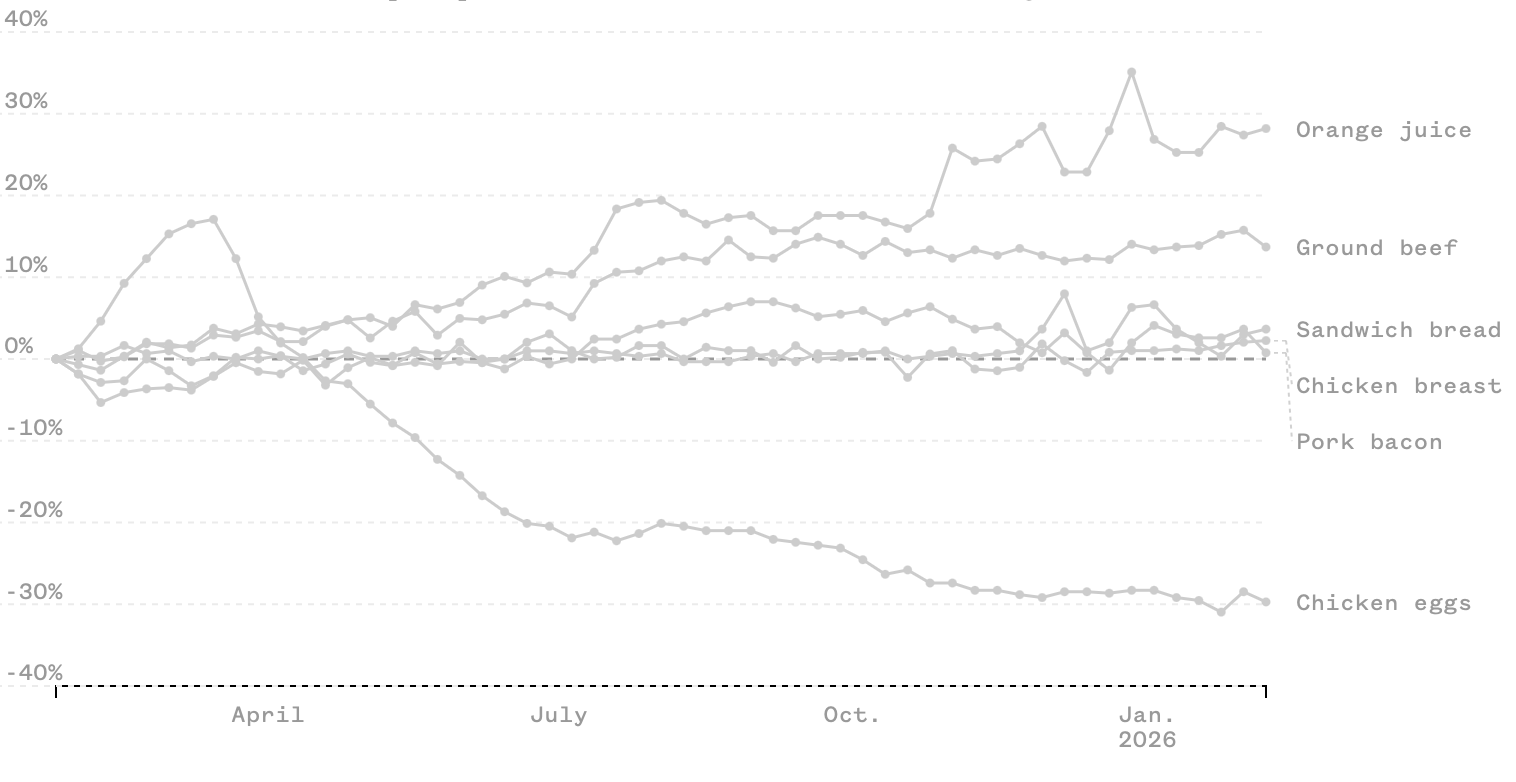
You have probably noticed that your grocery bill is higher than it used to be. Not just a little higher. Noticeably, consistently, frustratingly higher. Beef is up more than 15% from a year ago. Coffee hit record highs. Sugar, seafood, and cereal are all climbing. The USDA projects overall food prices will rise another 3.1% in 2026, and that estimate was made before the latest energy crisis.
The conventional explanation is that inflation is just part of life right now. New tariffs, supply chain disruptions, costs of packaging, and the pandemic hangover. All of these factors are possible factors. But there is a deeper, older, and less talked-about force working against your purchasing power that most people have never heard of. It is called the petrodollar system, and it has been quietly shaping the cost of everything you buy for over 50 years without you even knowing it.
In 1974, the United States struck a deal with oil producer Saudi Arabia. The terms were straightforward: Saudi Arabia would price its oil exclusively in U.S. dollars, and in return, America would provide military protection and security guarantees to the Saudi government. Other OPEC nations followed.
The consequence of that deal was enormous. Because oil is the world's most essential commodity and every country needs it, every country suddenly needed U.S. dollars to buy it. But here is the part most people miss — those dollars did not just flow in and flow back out. Oil-exporting nations like Saudi Arabia ended up accumulating billions of dollars from those transactions and instead of converting them back into their own currency, they parked them. They bought U.S. Treasury bonds, held dollar reserves, and reinvested in dollar-denominated assets. That created a permanent, artificial, global pool of demand for the U.S. dollar. Countries were not just using it to complete transactions, they were holding it as a store of value like gold. The more countries that held U.S. dollars in reserve, the stronger and more stable the U.S. dollar became. Not because of the strength of the American economy alone, but because of this arrangement — one that turned the U.S. dollar into the world's mandatory savings account.
This is the petrodollar system. And for decades it was very, very good for Americans.
Because the world needed U.S. dollars to buy oil, there was always strong global demand for American currency maintaining the strength of the U.S. dollar.A strong dollar means imports are cheap. Cheap imports mean lower prices at the store.
Think about everything you buy that comes from somewhere else. Electronics, clothing, food ingredients, cars. When the U.S. dollar is strong, all of those goods cost less. The petrodollar system has essentially given Americans a quiet, permanent discount on their standard of living, funded by the rest of the world's need to hold U.S. currency.
J.P. Morgan Asset Management describes this as the U.S. dollar's "exorbitant privilege" — the ability to fund deficits and maintain global purchasing power in a way no other nation can replicate. Having this de facto reserve currency is a privilege that has been baked into everyday American life for half a century.
Here is where it gets relevant to your wallet right now.
The petrodollar arrangement is slowly eroding. Not collapsing overnight, but weakening in ways that are real, measurable, and accelerating.
Roughly 20% of global crude oil trade is now being settled in non-dollar currencies, including the Chinese yuan, euro, and various local currencies. China, now the world's largest oil importer, has been systematically building an alternative payment infrastructure to bypass the U.S. dollar entirely. Iran has directed oil shipments to be settled in yuan. Saudi Arabia has signaled openness to accepting other currencies under its Vision 2030 strategy.
The U.S. dollar's share of global foreign exchange reserves has fallen from roughly 71% in 2000 to approximately 59% today, the steepest sustained decline since World War II. That number matters because it reflects how much of the world still trusts and needs the dollar as a store of value.
And the current conflict in the Strait of Hormuz — through which 25% of the world's seaborne oil trade passes — is accelerating all of this. With Iranian oil flowing to China and being settled entirely outside the U.S. banking system, the physical reality of global energy trade is changing faster than the political conversation.
Everything. Here is the direct line.
When global demand for dollars weakens, the dollar weakens. When the dollar weakens, imports cost more. When imports cost more, businesses pass those costs on to the consumer. Your grocery bill goes up. Your rent goes up. Everything you buy that involves a supply chain touched by international trade goes up.
J.P. Morgan's analysts note that inflation in 2026 will be sustained in part by the effects of a weakening dollar, alongside tariffs and fiscal pressure. These are not independent problems. They compound each other. A weaker dollar makes tariffs more painful. Tariffs on top of a weaker dollar make imports dramatically more expensive. And the petrodollar's erosion sits underneath all of it as a structural, long-term driver.
This is not a talking point or a theory. It is basic currency mechanics applied to the world's largest consumer economy.
When the purchasing power of a currency is under structural pressure, the logic of holding assets in that currency weakens. Cash loses value quietly. Bonds pay interest in the same depreciating currency. Stocks can hedge inflation but carry volatility.
Physical assets — real estate, commodities, land — have historically held their value through currency weakness because they exist independently of any monetary system. A house in Princeton, Texas does not care what the petrodollar does. The rent a tenant pays is denominated in whatever currency is in use, and the underlying asset retains its physical value regardless due to its utility.
This is one of the reasons exploring debt-free real estate is a particularly compelling structure right now. Properties with no mortgage have no interest rate sensitivity, no dollar-denominated debt to service, and no leverage amplifying the downside risk of a weakening currency environment. The asset simply exists, generates income, and holds value.
At Realbricks, every property is acquired debt-free. Investors buy shares starting with as little as $100 or as much as 9.8% of any single property on the platform. Investing with Realbricks is a simple way to gain exposure to physical real estate without taking on a mortgage of their own. In a world where your grocery bill is rising for reasons that have nothing to do with how much you spend, that kind of structural hedge is worth understanding.
The petrodollar system gave Americans a quiet discount on life for 50 years. As that system weakens, that discount goes away. The question is what you do about it.
Disclaimer: Investing in real estate involves risks, including the potential loss of capital. This content is for informational purposes only and is not intended as investment advice. Investors should perform their own research and consult with financial professionals before making investment decisions.
Be the first to know about property launches, portfolio updates, and announcements by subscribing to our newsletter.


Terra Mint Group, Corp ("Terra Mint"), as the Managing Member of Neptune REM, LLC ("Neptune") operates the RealBricks.com website (the "Site") and is not a broker-dealer or investment advisor. All securities related activity is conducted through Dalmore Group LLC, a registered broker-dealer and member of FINRA/SIPC, located at 525 Green Pl. Woodmere, NY 11598. You can review the brokercheck for Dalmore. An up-to-date Dalmore Form CRS is available.
You should speak with your financial advisor, accountant and/or attorney when evaluating any offering. Neither Terra Mint, Neptune, nor Dalmore makes any recommendations or provides advice about investments, and no communication, through this website or in any other medium, should be construed as a recommendation for any security offered on or off this investment platform. The Site may make forward-looking statements. You should not rely on these statements but should carefully evaluate the offering materials in assessing any investment opportunity, including the complete set of risk factors that are provided as part of the offering circular for your consideration.
Neptune is conducting public offerings pursuant to Regulation A, as amended, through the Site. The most current offering circular for Neptune is available here. Past performance is no guarantee of future results. Investments such as those on the Realbricks platform are speculative and involve substantial risks to consider before investing. These risks are outlined in the respective offering materials and including, but not limited to, illiquidity and a complete loss of capital. Key risks include, but are not limited to, limited operating history, reliance on key personnel, inherent risks in investing in real estate, distributions may not be received on predictable schedule and or at all by Investors, and lack of voting rights. Also, the adverse economic effects of the COVID-19 pandemic remain unknown and could materially impact this investment. An investment in an offering constitutes only an investment in a particular series and not in the underlying asset(s). Investors should carefully review the risks located in the respective offering materials for a more comprehensive discussion of risk.
From time to time, Neptune may undertake "testing the waters" for additional series of securities to be offered pursuant to Regulation A. For offerings that have not yet been qualified, no money or other consideration is being solicited, and if sent in response, will not be accepted.
NO MONEY OR OTHER CONSIDERATION IS BEING SOLICITED, AND IF SENT IN RESPONSE, WILL NOT BE ACCEPTED.
NO OFFER TO BUY THE SECURITIES CAN BE ACCEPTED AND NO PART OF THE PURCHASE PRICE CAN BE RECEIVED UNTIL THE OFFERING STATEMENT FILED BY THE COMPANY WITH THE SEC HAS BEEN QUALIFIED BY THE SEC. ANY SUCH OFFER MAY BE WITHDRAWN OR REVOKED, WITHOUT OBLIGATION OR COMMITMENT OF ANY KIND, AT ANY TIME BEFORE NOTICE OF ACCEPTANCE GIVEN AFTER THE DATE OF QUALIFICATION.
AN INDICATION OF INTEREST INVOLVES NO OBLIGATION OR COMMITMENT OF ANY KIND.
AN OFFERING STATEMENT REGARDING THIS OFFERING HAS BEEN FILED WITH THE SEC. YOU MAY OBTAIN A COPY OF THE PRELIMINARY OFFERING CIRCULAR THAT IS PART OF THAT OFFERING STATEMENT FROM: Neptune REM, LLC 412 W Norfolk Ave STE 2, Norfolk, NE 68701 OR HERE.
Investment overviews contained herein contain summaries of the purpose and the principal business terms of the investment opportunities. Such summaries are intended for informational purposes only and do not purport to be complete, and each is qualified in its entirety by reference to the more-detailed discussions contained in the respective offering circular filed with the SEC.
Realbricks does not offer refunds after an investment has been made. Please review the relevant offering materials and subscription documentation for more information.
Potential investors should not rely on any forward-looking statements regarding any investment opportunity, which is based on our beliefs and information currently available to us. The words “anticipate,” “believe,” “expect,” “aim,” “potential,” “design,” “target,” “intend,” “may,” “might,” “plan,” “estimate,” “project,” “projection,” “should,” “will,” “would,” “result” and similar expressions identify forward-looking statements. Such statements are subject to risks, uncertainties, and assumptions and are not guarantees of future performance, which may be affected by known and unknown risks, trends, uncertainties, and factors that are beyond our control. These risks could result in the loss of your investment. See the offering materials for detailed information.
Neptune does not have a public trading market for its Series Interests. While it intends to seek a quotation on PPEX, an alternative trading system (ATS) operated by North Capital Investment Technology, Inc. (“PPEX”) with a view to providing our holders of Series Interests with potential liquidity in the form of a secondary market for their investment in our Series Interests. However, there can be no guarantee that a secondary market may develop, or if it does, as to the volume or pricing with respect to any secondary trading that might develop. The PPEX does not employ market makers to provide liquidity, unlike national securities exchanges. Until Neptune’s Series Interests are listed, if ever, you may not sell the company’s Series Interests. Therefore, it may be difficult for you to sell Neptune’s Series Interests at the time you wish to do so, if you are able to sell them at all. If you are able to sell your Series Interests, you may have to sell them at a substantial discount to their public offering price. Because of the illiquid nature of our Series Interests, you should purchase Neptune’s Series Interests only as a long-term investment and be prepared to hold them for an indefinite period of time.
Property information shown has been provided from various sources, which can include the seller and/or public records. It is believed reliable but not guaranteed and should not be relied upon without independent verification.
Disclaimer: Images, Information and Floor Plan and Measurements are approximate and are for illustrative purposes only. We make no guarantee, warranty or representation as to the accuracy and completeness of the floor plans, measurements and or any information provided. You or your advisers should conduct a careful, independent investigation of the property to determine to your satisfaction as to the suitability of the property for your space requirements. All pricing and availability is subject to change. The information is to be used as a point of reference and not a binding agreement.


