

Compare Realbricks with Arrived, Fundrise, Roots, Groundfloor, and Lofty. Explore differences in investment structures, property selection, financing, distributions and liquidity, and learn why Realbricks stands apart.
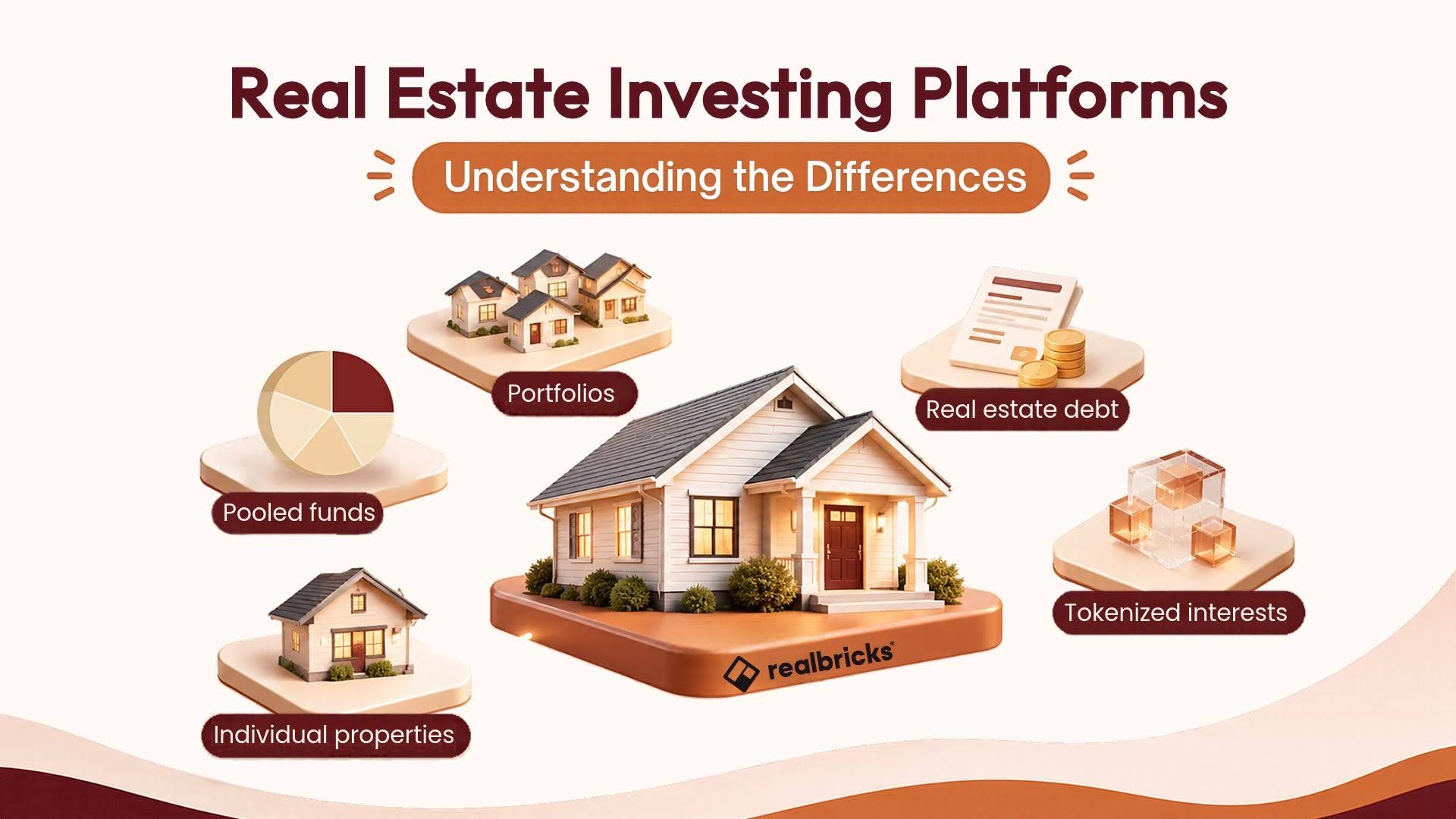
Technology has expanded the ways individuals can participate in real estate investing. Today, platforms offer opportunities to invest in individual rental properties, diversified real estate portfolios, property-backed loans, and tokenized real estate interests, often without purchasing or managing an entire property.
While these platforms share a goal of making real estate investments more accessible, they differ in how investments are structured, how income is generated, and how investors may access their funds.
Realbricks, Arrived, Fundrise, Roots, Groundfloor, and Lofty represent several distinct approaches to real estate investing. Understanding these differences can help investors evaluate the features, risks, and limitations associated with each model.
This guide examines five important considerations:
Realbricks distinguishes itself by offering investors the ability to select individual rental property investments through SEC-qualified offerings, with access to property-level information and a digital platform for managing their investments. For those comparing real estate investing platforms, Realbricks provides an alternative to pooled investment funds, real estate lending products, and tokenized ownership models, with a focus on transparency, accessibility, and investor education.
One of the most important differences among real estate investing platforms is what investors actually purchase. Some platforms provide ownership interests associated with specific properties, while others offer shares in diversified investment funds or exposure to real estate loans.
Realbricks offers fractional real estate investments through SEC-qualified offerings tied to individual rental properties. Investors purchase ownership interests in the entity that owns a particular property, rather than receiving direct ownership or title to the real estate.
Each offering is associated with a specific rental property, a real asset. Investors are able to review available property information, offering documents, and financial disclosures before making an investment decision.
Investors can select among available offerings and determine how to allocate their investments across individual properties with investment opportunities available on the Realbricks Primary and Secondary Markets.
Arrived offers investments associated with individual properties, including single-family rentals and vacation rentals, as well as pooled investment funds. Like Realbricks, its individual property offerings provide exposure to specific assets through an investment entity.
Fundrise primarily offers pooled investment products, including real estate funds. Investors generally purchase interests in a fund rather than selecting individual rental properties. Fund managers determine the underlying investments according to each fund's strategy.
Roots offers a portfolio-based real estate investment model through a real estate investment trust (REIT). Investors participate in a managed portfolio rather than purchasing interests associated with individual properties of their choosing. For a more focused comparison, check out this article on REITs vs. Fractional Real Estate Investing.
Groundfloor primarily offers real estate debt investments. Instead of purchasing equity interests tied to rental properties, investors participate in loans associated with real estate projects. Returns depend on the terms and repayment performance of the underlying loans.
Lofty uses blockchain technology to facilitate investments in tokenized ownership interests associated with individual rental properties. Its model differs from conventional share-based platforms in how ownership interests and transactions are represented and administered.
Realbricks emphasizes property-level selection within an equity-based investment structure.
Fundrise and Roots emphasize managed portfolios, Groundfloor focuses on real estate lending, and Lofty uses tokenized interests. Arrived offers a closer comparison to Realbricks through its individual-property investments.
Property-specific investing gives investors more discretion over which available properties they select, but it also exposes each investment to the operating and financial performance of that particular property. Pooled funds may spread exposure across multiple assets, although diversification does not eliminate investment risk.

Real estate investment platforms may use different financing arrangements to acquire properties or fund investment activities. Some investments use mortgage financing or other borrowing arrangements, while others rely primarily on investor capital. These decisions can influence operating expenses, cash flow, financial obligations, and exposure to market fluctuations.
Understanding how an investment uses financing can help investors evaluate its financial structure and associated risks.
Realbricks structures its offerings around individual rental properties, with property acquisitions generally funded through capital raised from investors rather than property-level mortgage financing. Investors purchase shares in the entity that owns the property, and the property's operating results depend on rental income, expenses, reserves, and other financial considerations.
Without recurring mortgage payments as part of the underlying property's acquisition structure, operating expenses primarily reflect property management, maintenance, taxes, insurance, and other costs associated with owning and operating the property.
Arrived may use mortgage financing in certain property offerings. The use and amount of borrowing can vary by investment, making the financial disclosures for each property important to review.
Fundrise funds may use leverage as part of their investment strategies. Financing arrangements depend on the underlying assets, fund objectives, and investment products involved.
Roots operates through a managed real estate portfolio. Investors can review the fund's offering documents and financial statements to understand its financing arrangements and any associated debt obligations.
Groundfloor takes a different approach by providing exposure to real estate lending. Investors participate in loans associated with real estate projects, making borrower repayment, collateral, and loan terms central considerations.
Lofty provides investments associated with individual properties. Financing arrangements may vary by property, and investors should review the applicable disclosures to understand any mortgage obligations or other liabilities.
Realbricks generally acquires properties using investor capital rather than property-level mortgage financing, while other platforms may incorporate borrowing into their acquisition or investment strategies. This type of leverage can affect investment outcomes by increasing financial obligations and potentially amplifying both gains and losses.
Neither approach guarantees a particular level of income, appreciation, or investment performance. Investors should evaluate financing arrangements alongside property operating results, expenses, reserves, and market conditions.
Real estate investments can generate income through rental operations, loan interest, or other investment activities. The timing, amount, and availability of distributions depend on the investment structure and underlying performance.
On Realbricks, potential distributions are tied to the operating results of the underlying rental property. If a property generates positive net operating income and distributions are declared for a given reporting period, investors receive distributions in proportion to their ownership interests or number of shares in that offering, subject to the offering terms.
Realbricks evaluates distributions quarterly; however, distributions are not guaranteed.
Several factors may affect whether distributions are made, including rental occupancy and tenant payments, property management and maintenance expenses, taxes and insurance, repairs and capital expenditures, and property-level reserves and other operating requirements.
Arrived offers rental income distributions associated with eligible property investments, generally evaluated on a quarterly basis. Payments depend on the underlying investment.
Fundrise distributes income according to the terms of its individual funds. Distribution schedules and amounts may differ among investment products.
Roots offers distributions associated with the performance of its managed real estate portfolio, subject to the fund's terms and available cash.
Groundfloor investors generally seek interest income through real estate loans. Payments depend on loan terms, repayment timing, and borrower performance.
Lofty offers a model designed to facilitate more frequent rental income payments through its technology infrastructure, subject to property performance and applicable payment arrangements.
Realbricks connects potential distributions to each property’s operating performance, rather than a pooled fund or loan portfolio. Investors can review property-level operating information to understand the factors affecting historical results.
More frequent distributions do not necessarily indicate greater profitability, and quarterly distribution schedules do not guarantee regular payments. Investors should evaluate the source of income, associated expenses, and risks rather than relying on payment frequency alone.
Real estate is generally considered an illiquid asset, and fractional real estate investments may be difficult to exit before the underlying property is sold. Some platforms offer redemption programs, while others provide secondary marketplaces or rely on loan repayments.
Realbricks offers a Secondary Market designed to allow eligible investors to place buy and sell orders for shares associated with participating offerings. Unlike the Primary Market, where investors purchase shares through an initial offering, the Secondary Market facilitates transactions between eligible investors.
Participation is subject to applicable account eligibility requirements, offering availability, holding periods, and transaction rules. A sell order must match with a corresponding buy order for a transaction to occur. There is no guarantee that shares can be sold, that a buyer will be available, or that a transaction will occur at a particular price or within a particular timeframe.
If a property is eventually sold, investors who hold shares in the applicable offering may participate in the resulting proceeds according to the ownership structure and terms described in the offering documents.
Arrived offers secondary market opportunities for eligible individual-property investments through designated trading windows. Fund investments may also have redemption options, subject to holding periods and other restrictions.
Fundrise provides redemption opportunities for certain funds, generally through scheduled liquidity windows. Redemptions may be limited, delayed, or suspended under applicable fund terms.
Roots offers a redemption framework subject to the fund's eligibility requirements, redemption limitations, and applicable fees.
Groundfloor investments generally depend on repayment or resolution of the underlying real estate loans. Repayment may occur later than anticipated, particularly if a borrower defaults or a loan requires additional servicing or recovery efforts.
Lofty offers a marketplace for transactions involving tokenized property interests. The ability to sell depends on market participation, pricing, and other applicable restrictions.
Realbricks uses a peer-to-peer transaction model for eligible property-specific shares, rather than relying exclusively on fund redemptions or the maturity of an underlying loan.
This creates a potential avenue for resale, but it does not eliminate the illiquid nature of real estate securities or guarantee that an investor can exit an investment when desired.
The amount required to begin investing is only one component of accessibility. Investors should also consider transaction costs, ongoing management fees, account requirements, available investment products, and how easily they can review investment information.
Realbricks provides access to fractional real estate investing through individual investment accounts with minimum investments starting at $100 on the Primary Market (10 shares for $10 per share). Additional account types are available, including Entity or Trust accounts as well as Self-Directed IRA accounts (coming soon), subject to eligibility and applicable terms.
The Realbricks platform is accessible through its website and mobile applications (Apple iOS and Google Play). Investors can review available offerings on the Realbricks marketplace, access offering documents, manage account information, and monitor their investments.
Realbricks also provides educational resources and customer support to help users understand platform functionality and the mechanics of fractional real estate investing.
Arrived offers access to individual property investments and pooled funds through its digital platform. Minimums and fees depend on the investment product.
Fundrise offers certain investment products beginning at $10, with other products and account types subject to different minimums and eligibility requirements.
Roots offers a portfolio-based investment experience with a relatively low entry minimum, although investors do not select individual properties within the fund.
Groundfloor offers certain real estate debt investments with low minimums, allowing investors to allocate capital across multiple loans.
Lofty provides a technology-focused experience centered on tokenized real estate interests. Investors should review its account, payment, and transaction requirements to understand how the platform operates.
Realbricks combines property-specific investment opportunities with web and mobile access, allowing investors to browse individual rental properties, review offering documents, and manage their investments through a single platform.
While platforms such as Fundrise and Groundfloor offer lower investment minimums for certain products, Realbricks provides access to individual property offerings starting at $100 for eligible individual investors. Unlike platforms focused primarily on pooled funds or real estate lending, Realbricks allows investors to select specific rental property offerings.
Fees also vary across platforms. Realbricks uses a combination of transaction fees and ongoing asset and property management fees, while competitors may charge fund management fees, redemption fees, or other investment-specific costs.
The primary distinction is Realbricks' combination of individual property selection, digital account management, and a defined fee structure. Investors should compare total costs, account requirements, available investment options, and platform features when evaluating these differences.
Platform features, minimums, fees, and investment availability may change. The information above describes general investment models and should be verified against each platform's current disclosures and applicable offering documents.
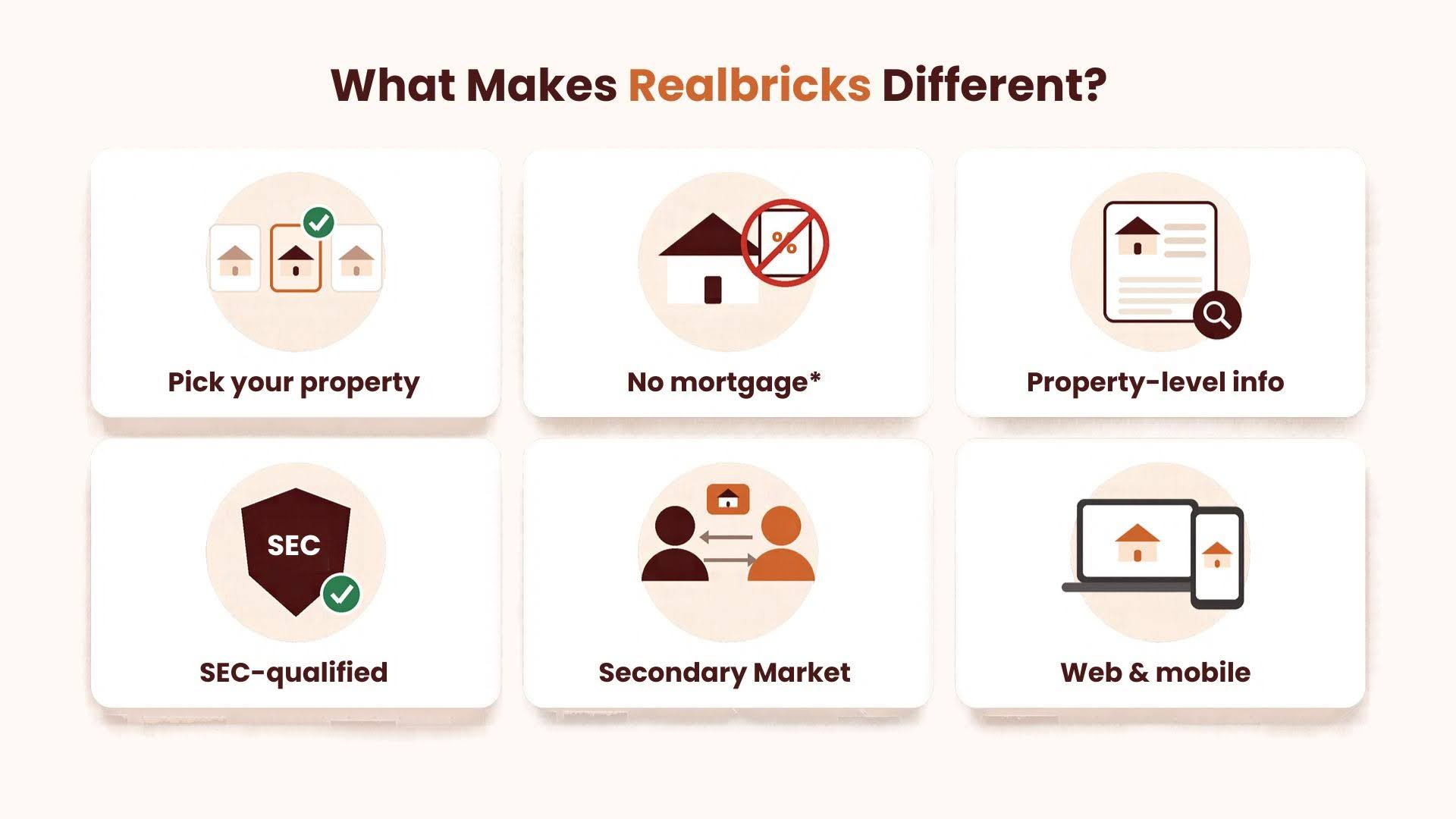
Although several platforms provide access to real estate investments with relatively small amounts of capital, Realbricks combines several specific characteristics.
Individual property selection: Investors choose among available offerings tied to identifiable rental properties rather than investing exclusively through a pooled portfolio.
Property acquisition structure: Realbricks generally funds property acquisitions using investor capital rather than property-level mortgage financing. This represents one approach to structuring real estate investments and does not eliminate investment risk.
Property-level reporting: Investors can review offering information and historical operating results associated with individual properties. Actual results may differ significantly between offerings and reporting periods.
SEC-qualified offerings: Realbricks provides offerings qualified by the SEC under Regulation A. SEC qualification does not represent an endorsement of the investment or a determination that the investment is safe or appropriate for any particular investor.
Secondary Market participation: Eligible investors may place orders to purchase or sell shares of participating offerings with other Realbricks users, subject to availability and applicable terms.
Digital account management: Investors can access the Realbricks platform through its website and mobile applications, with tools for reviewing offerings and managing their accounts.
These features define Realbricks' approach to modernize real estate investing.
There is no single investment structure that addresses every investor's objectives or risk considerations.
An investor evaluating property-specific investments may focus on the financial and operating characteristics of individual properties. Someone evaluating a pooled fund may place greater emphasis on portfolio composition, diversification, and fund management.
Real estate debt investments introduce considerations related to borrower repayment, loan terms, and collateral, while tokenized investments may involve additional technology, transaction, and custody considerations.
Regardless of the platform, investors should review the applicable offering documents, financing arrangements, fee schedules, investment restrictions, and risk disclosures before making a decision.
Through its property-specific investment structure, property-level reporting, and digital marketplace, the Realbricks platform offers an approach to modernize real estate investing, one brick at a time.
Investors can review available properties, examine offering documents, and learn more about how fractional ownership works through the Realbricks Resource Library.
Disclaimer: Investing in real estate involves risks, including the potential loss of capital. This content is for informational purposes only and is not intended as investment advice. A debt-free property structure reduces certain risks but does not eliminate the risks of real estate investing, including vacancy, maintenance costs, and changes in property value. Distributions are not guaranteed and depend on a property being tenanted, collecting rent, and generating net operating income. Investors should perform their own research and consult with financial professionals before making investment decisions.
Be the first to know about property launches, portfolio updates, and announcements by subscribing to our newsletter.


**Bonus Share Match Promotion Details.** From November 16 through December 31, 2026, eligible existing Realbricks investors may receive a 10% bonus share match on one qualifying investment in an available SEC-qualified Primary Market offering, subject to offering minimums. To enroll, communicate code **MATCH10** to Realbricks by text, email, or another approved method. Unless otherwise approved by the Issuer in writing, the promotion applies to the next qualifying investment after enrollment. Bonus shares are calculated as 10% of shares purchased, rounded up to the nearest whole share, and issued in the same offering after the investment is accepted and funds clear.
**New Investor Promotion Details.** From November 16 through December 31, 2026, eligible new investors with a verified Realbricks account may receive **$50 in bonus shares** (five shares at the current offering price) on their first qualifying Primary Market investment of at least $100, subject to any higher offering minimum. Enter code **REALBRICKS50** when submitting the investment. Bonus shares are issued in the same offering after the investment is accepted and funds clear.
**Additional Terms.** Subject to the Offering Circular and applicable law, Neptune REM, LLC (the “Issuer”) may approve alternative enrollment methods, code corrections, processing accommodations, or another qualifying transaction, with exceptions confirmed in writing. Limit one bonus per investor under each promotion; promotions cannot be combined unless expressly authorized. All bonuses remain subject to applicable eligibility requirements, account exclusions, ownership limits, transfer restrictions, and promotional-share availability. Funds typically clear within 3–5 business days; bonus issuance may take longer.
Terra Mint Group, Corp ("Terra Mint"), as the Managing Member of Neptune REM, LLC ("Neptune") operates the RealBricks.com website (the "Site") and is not a broker-dealer or investment advisor. All securities related activity is conducted through Dalmore Group LLC, a registered broker-dealer and member of FINRA/SIPC, located at 525 Green Pl. Woodmere, NY 11598. You can review the brokercheck for Dalmore. An up-to-date Dalmore Form CRS is available.
You should speak with your financial advisor, accountant and/or attorney when evaluating any offering. Neither Terra Mint, Neptune, nor Dalmore makes any recommendations or provides advice about investments, and no communication, through this website or in any other medium, should be construed as a recommendation for any security offered on or off this investment platform. The Site may make forward-looking statements. You should not rely on these statements but should carefully evaluate the offering materials in assessing any investment opportunity, including the complete set of risk factors that are provided as part of the offering circular for your consideration.
Neptune is conducting public offerings pursuant to Regulation A, as amended, through the Site. The most current offering circular for Neptune is available here. Past performance is no guarantee of future results. Investments such as those on the Realbricks platform are speculative and involve substantial risks to consider before investing. These risks are outlined in the respective offering materials and including, but not limited to, illiquidity and a complete loss of capital. Key risks include, but are not limited to, limited operating history, reliance on key personnel, inherent risks in investing in real estate, distributions may not be received on predictable schedule and or at all by Investors, and lack of voting rights. Also, the adverse economic effects of the COVID-19 pandemic remain unknown and could materially impact this investment. An investment in an offering constitutes only an investment in a particular series and not in the underlying asset(s). Investors should carefully review the risks located in the respective offering materials for a more comprehensive discussion of risk.
From time to time, Neptune may undertake "testing the waters" for additional series of securities to be offered pursuant to Regulation A. For offerings that have not yet been qualified, no money or other consideration is being solicited, and if sent in response, will not be accepted.
NO MONEY OR OTHER CONSIDERATION IS BEING SOLICITED, AND IF SENT IN RESPONSE, WILL NOT BE ACCEPTED.
NO OFFER TO BUY THE SECURITIES CAN BE ACCEPTED AND NO PART OF THE PURCHASE PRICE CAN BE RECEIVED UNTIL THE OFFERING STATEMENT FILED BY THE COMPANY WITH THE SEC HAS BEEN QUALIFIED BY THE SEC. ANY SUCH OFFER MAY BE WITHDRAWN OR REVOKED, WITHOUT OBLIGATION OR COMMITMENT OF ANY KIND, AT ANY TIME BEFORE NOTICE OF ACCEPTANCE GIVEN AFTER THE DATE OF QUALIFICATION.
AN INDICATION OF INTEREST INVOLVES NO OBLIGATION OR COMMITMENT OF ANY KIND.
AN OFFERING STATEMENT REGARDING THIS OFFERING HAS BEEN FILED WITH THE SEC. YOU MAY OBTAIN A COPY OF THE PRELIMINARY OFFERING CIRCULAR THAT IS PART OF THAT OFFERING STATEMENT FROM: Neptune REM, LLC 412 W Norfolk Ave STE 2, Norfolk, NE 68701 OR HERE.
Investment overviews contained herein contain summaries of the purpose and the principal business terms of the investment opportunities. Such summaries are intended for informational purposes only and do not purport to be complete, and each is qualified in its entirety by reference to the more-detailed discussions contained in the respective offering circular filed with the SEC.
Realbricks does not offer refunds after an investment has been made. Please review the relevant offering materials and subscription documentation for more information.
Potential investors should not rely on any forward-looking statements regarding any investment opportunity, which is based on our beliefs and information currently available to us. The words “anticipate,” “believe,” “expect,” “aim,” “potential,” “design,” “target,” “intend,” “may,” “might,” “plan,” “estimate,” “project,” “projection,” “should,” “will,” “would,” “result” and similar expressions identify forward-looking statements. Such statements are subject to risks, uncertainties, and assumptions and are not guarantees of future performance, which may be affected by known and unknown risks, trends, uncertainties, and factors that are beyond our control. These risks could result in the loss of your investment. See the offering materials for detailed information.
Neptune does not have a public trading market for its Series Interests. While it intends to seek a quotation on PPEX, an alternative trading system (ATS) operated by North Capital Investment Technology, Inc. (“PPEX”) with a view to providing our holders of Series Interests with potential liquidity in the form of a secondary market for their investment in our Series Interests. However, there can be no guarantee that a secondary market may develop, or if it does, as to the volume or pricing with respect to any secondary trading that might develop. The PPEX does not employ market makers to provide liquidity, unlike national securities exchanges. Until Neptune’s Series Interests are listed, if ever, you may not sell the company’s Series Interests. Therefore, it may be difficult for you to sell Neptune’s Series Interests at the time you wish to do so, if you are able to sell them at all. If you are able to sell your Series Interests, you may have to sell them at a substantial discount to their public offering price. Because of the illiquid nature of our Series Interests, you should purchase Neptune’s Series Interests only as a long-term investment and be prepared to hold them for an indefinite period of time.
Property information shown has been provided from various sources, which can include the seller and/or public records. It is believed reliable but not guaranteed and should not be relied upon without independent verification.
Disclaimer: Images, Information and Floor Plan and Measurements are approximate and are for illustrative purposes only. We make no guarantee, warranty or representation as to the accuracy and completeness of the floor plans, measurements and or any information provided. You or your advisers should conduct a careful, independent investigation of the property to determine to your satisfaction as to the suitability of the property for your space requirements. All pricing and availability is subject to change. The information is to be used as a point of reference and not a binding agreement.


